The Street Art and Paintings of Wes21

The Street Art and Paintings of Wes21 street art science fiction painting murals

The Street Art and Paintings of Wes21 street art science fiction painting murals

The Street Art and Paintings of Wes21 street art science fiction painting murals

The Street Art and Paintings of Wes21 street art science fiction painting murals

The Street Art and Paintings of Wes21 street art science fiction painting murals

The Street Art and Paintings of Wes21 street art science fiction painting murals

The Street Art and Paintings of Wes21 street art science fiction painting murals

The Street Art and Paintings of Wes21 street art science fiction painting murals

The Street Art and Paintings of Wes21 street art science fiction painting murals

The Street Art and Paintings of Wes21 street art science fiction painting murals

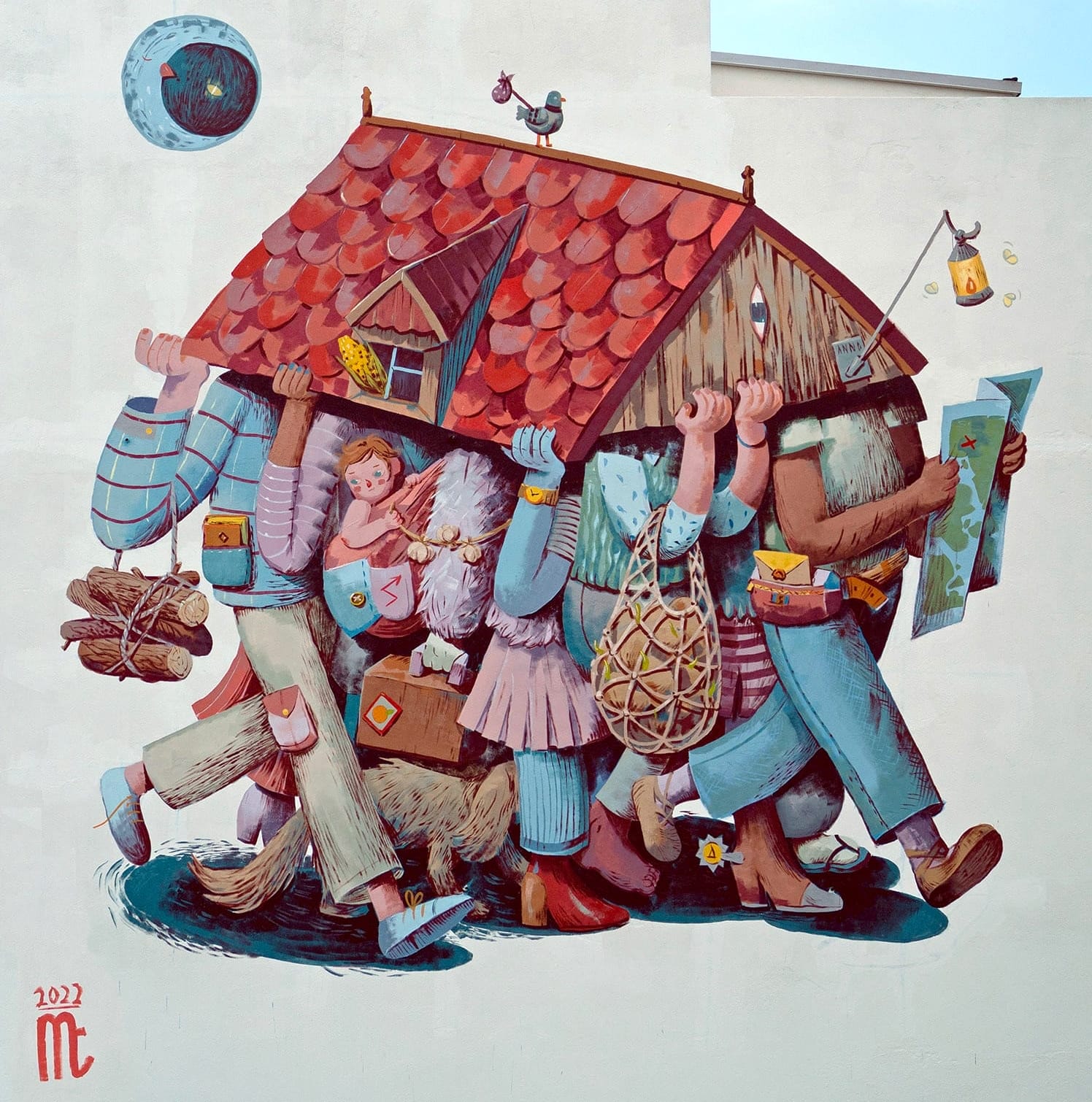
Swiss artist Remo Lienhard (aka Wes21) has an imagination to kill for. His acrylic and spray paint works are explosively detailed and often depict a sort of dystopian fusion of people and the natural world. Though despite the grittiness and abundance of detail found in each of his works it’s clear he also possesses a keen sense of humor. Lienhard belongs to a collective of graffiti artists and illustrators called Schwarzmaler where you can find much more of his street art and other works. Also don’t miss him over on Facebook. (via street art utopia which has a killer roundup of street art this month)

Update: Wes21 is represented by SOON where you can learn more about his work.

By Christopher on          

Here & There: Horizonless Projections of Manhattan

Here & There: Horizonless Projections of Manhattan posters and prints New York maps

Here & There: Horizonless Projections of Manhattan posters and prints New York maps

Here & There are a fascinating set of prints from London-based design firm BERG that depict speculative projections of Manhattan by completely removing the horizon and skewing the entire urban landscape upward. These particular views are of uptown from 3rd and 7th street, and downtown from 3rd and 35th street. Last year the prints found their way into MOMA’s permanent collection, and have just been reprinted using offset litho on 170 gsm paper from sustainable sources. Pick ‘em up now, shipping starts tomorrow.

Update: Because people are asking, these were designed a year or two before Inception. Just sayin’.

By Christopher on       

The Thorncrown Chapel, an Idyllic Glass Chapel in Rural Arkansas is Under Threat

The Thorncrown Chapel, an Idyllic Glass Chapel in Rural Arkansas is Under Threat environment churches Arkansas architecture

The Thorncrown Chapel, an Idyllic Glass Chapel in Rural Arkansas is Under Threat environment churches Arkansas architecture

The Thorncrown Chapel, an Idyllic Glass Chapel in Rural Arkansas is Under Threat environment churches Arkansas architecture

The Thorncrown Chapel, an Idyllic Glass Chapel in Rural Arkansas is Under Threat environment churches Arkansas architecture

The Thorncrown Chapel in Eureka Springs, Arkansas is considered one of the crowning examples of organic architecture, a philosophy credited to Frank Lloyd Wright that promotes a harmony between the natural world and human habitation. The non-denominational chapel was designed in 1980 by an apprentice of Wright’s, architect E. Fay Jones, who employed the use of steel and glass to create a weightless, almost translucent structure that offers sweeping views in all directions of the surrounding Ozark habitat. In keeping with the organic design of the chapel Fay asked that no construction element be larger than what two people could carry through the woods by hand.

Recently a power company has applied to build a 48-mile high voltage transmission line through Northwest Arkansas that will cut through the woods right next to the chapel, shattering the views and serenity offered by the extremely unique building that was placed on the National Register of Historic Places in 2000. For those interested, the Arkansas Public Service Commission is accepting comments from the public regarding the proposed power line construction. You can also read much more over on Hyperallergic.

By Christopher on          

A Rainbow of Shoes and Legs for Breuninger by John Breed

A Rainbow of Shoes and Legs for Breuninger by John Breed shoes sculpture rainbows installation anatomy

A Rainbow of Shoes and Legs for Breuninger by John Breed shoes sculpture rainbows installation anatomy

A Rainbow of Shoes and Legs for Breuninger by John Breed shoes sculpture rainbows installation anatomy

A Rainbow of Shoes and Legs for Breuninger by John Breed shoes sculpture rainbows installation anatomy

A Rainbow of Shoes and Legs for Breuninger by John Breed shoes sculpture rainbows installation anatomy

Netherlands-based artist John Breed installed this whimsical leg rainbow in conjunction with German shoe salon Breuninger last year. The piece involved 145 multicolored shoes and legs that were eventually placed near the salon. See more on his website. (via show slow)

By Christopher on             

[Sponsor] Submit your Artwork to UncommonGoods’ Monthly Art Contest

Artists are now welcome to submit their latest artwork to UncommonGoods’ monthly art contest where it will be placed in front of UncommonGoods buyers. Every month, the chosen winner receives $500, an UncommonGoods vendor contract, and national exposure.

After the call for entries, the semifinalist designs chosen by the UncommonGoods buyers will appear on UncommonGoods.com where the online community will vote on their favorite pieces to move on to the final round. The top five voted designs will be judged by their buyers and a winner will be chosen. Designers and artists are welcome to submit their masterpieces on their contest page.

You can also check out their Uncommon Artist Gallery where you can find artwork for sale from dozens of talented artists. UncommonGoods also sells personalized wall art, handmade frames, and sculptures which can be found in this assortment.[Sponsor] Submit your Artwork to UncommonGoods’ Monthly Art Contest sponsor

By Christopher on

Things Come Apart, 50 Disassembled Objects in 21,959 Individual Parts by Todd McLellan

Things Come Apart, 50 Disassembled Objects in 21,959 Individual Parts by Todd McLellan objects books
Bicycle, 1980s; Raleigh; Component count: 893. Photo reproduced with the permission of Thames & Hudson.

Things Come Apart, 50 Disassembled Objects in 21,959 Individual Parts by Todd McLellan objects books
Bicycle, 1980s; Raleigh; Component count: 893. Photo reproduced with the permission of Thames & Hudson.

Things Come Apart, 50 Disassembled Objects in 21,959 Individual Parts by Todd McLellan objects books
Chainsaw, 1990s; Homelite; Component count: 286. Photo reproduced with the permission of Thames & Hudson.

Things Come Apart, 50 Disassembled Objects in 21,959 Individual Parts by Todd McLellan objects books
Laptop Computer, 2006; Apple; Component count: 639. Photo reproduced with the permission of Thames & Hudson.

Things Come Apart, 50 Disassembled Objects in 21,959 Individual Parts by Todd McLellan objects books
Children’s Wagon, 2011; Schwinn; Component count: 296. Photo reproduced with the permission of Thames & Hudson.

Things Come Apart, 50 Disassembled Objects in 21,959 Individual Parts by Todd McLellan objects books
Smartphone, 2007; BlackBerry; Component count: 120. Photo reproduced with the permission of Thames & Hudson.

Things Come Apart, 50 Disassembled Objects in 21,959 Individual Parts by Todd McLellan objects books
Smartphone, 2007; BlackBerry; Component count: 120. Photo reproduced with the permission of Thames & Hudson.

Things Come Apart, 50 Disassembled Objects in 21,959 Individual Parts by Todd McLellan objects books
Swiss Army Knife, 2000s; Victorinox; Component count: 38.

Things Come Apart, 50 Disassembled Objects in 21,959 Individual Parts by Todd McLellan objects books

I’ll never forget the excitement I felt the first time I disassembled a telephone. I was eight years old, on our back porch with just an old screwdriver and a pair of pliers, but seeing what was inside this everyday object was a discovery akin to unearthing a dinosaur. The sudden knowledge that the speaker part was magnetic and contained a mile of thin copper wiring was practically miraculous. When the day was over, I was surrounded by pieces of am/fm radio, an old handheld video game, and a toy car, none of which would ever be assembled again, but that really wasn’t the point. Master disassembler Todd McLellan remarks on a similar childhood discovery in his latest book, Things Come Apart from Thames & Hudson, but for him, it wasn’t fleeting like it was with me. It was the beginning of his life-long career in documenting the technological methods of modern mass production in reverse.

In Things Come Apart, McLellan exposes the inner working of 50 objects and 21,959 individual components as he reflects on the permanence of vintage machines built several decades ago—sturdy gadgets meant to be broken and repaired—versus today’s manufacturing trend of limited use followed by quick obsolescence. Captured in his photography are myriad parts laid flat and organized by function, creating recontextualized images of wagons, chainsaws, computers, and phones. He also shoots high-speed photos of carefully orchestrated drops where pieces are shot in midair as they come crashing down, creating impressive visual explosions. Also appearing in the book is his pièce de résistance: a Zenith CH 650 aircraft photographed as individual components.

The book is officially published tomorrow, but you can order it now on Amazon and Thames & Hudson. All images copyright Todd McLellan courtesy of the publisher.

Update: If you’re in Chicago, McLellan currently has an exhibition at the Museum of Science and Industry through May 19th.

By Christopher on    

Raw Data: A Hand-Drawn Animation with Ink, Gouache, White-out and Coffee

Raw Data: A Hand Drawn Animation with Ink, Gouache, White out and Coffee painting coffee animation

Raw Data: A Hand Drawn Animation with Ink, Gouache, White out and Coffee painting coffee animation

Behold the latest work from animator Jake Fried (previously) who works with layer after layer of ink, gouache, white-out and coffee to create deeply textured and truly psychedelic animated shorts. Fried lives and works in Boston where he is primarily known for his painting, but has recently begun focusing on these experimental animations he refers to has “moving paintings,” many more of which you can see on his website.

By Christopher on       

Stranger Visions: DNA Collected from Found Objects Used to Create 3D Portraits

Stranger Visions: DNA Collected from Found Objects Used to Create 3D Portraits science portraits genetics DNA 3d printing

You’re walking down a street in Brooklyn, gnawing on a piece of gum that’s past the point of flavorful.. In a hurry, you spit it on the ground without a second thought and continue about your day. Hours later, a mysterious woman arrives, surreptitiously collecting the sticky gum from the sidewalk and dropping it into a clear plastic bag which she then carefully labels. Flash forward a month later: you’re walking through an art gallery, and there, mounted on the wall, is a familiar face staring back at you. Astonishingly (or terrifyingly), it’s a 3D print of your face generated from the DNA you left behind on that random piece of gum that now appears in a petri dish just below the portrait. A few years ago this would have seemed like science fiction, the stuff of films like Gattaca, but to information artist Heather Dewey-Hagborg, it’s how she makes her artwork here in 2013.

They say inspiration can strike anywhere. For Dewey-Hagborg, it happened in a therapy session. While staring at a framed print on the wall, she fixated on a tiny crack in the glass into which a small hair had become lodged. As her mind wandered, she imagined who this seemingly insignificant hair belonged to, and, more specifically, what they might look like. After that day, she became keenly aware of the genetic trail left by every person in their daily life, and began to question what physical characteristics could be identified through the DNA left behind on a piece of gum or cigarette butt.

Stranger Visions: DNA Collected from Found Objects Used to Create 3D Portraits science portraits genetics DNA 3d printing
Sample Location 6. January 6, 2013 at 12:25pm; Wilson ave. and Stanhope St. Brooklyn, NY; MtDNA Haplogroup: D1 (Native American, South American); SRY Gene: present; Gender: Male; HERC2 Gene: AA; Eye Color: Brown

Stranger Visions: DNA Collected from Found Objects Used to Create 3D Portraits science portraits genetics DNA 3d printing

Stranger Visions is the result of her fascinating, if slightly disconcerting, line of questioning and experimentation: 3D printed portraits based on DNA samples taken from objects found on the streets of Brooklyn. Dewey-Hagborg worked with a DIY biology lab called Genspace, where she met a number of biologists who taught her everything she now knows about molecular biology and DNA. Via an interview with the artist:

So I extract the DNA in the lab and then I amplify certain regions of it using a technique called PCR – Polymerase Chain Reaction. This allows me to study certain regions of the genome that tend to vary person to person, what are called SNPs or Single Nucleotide Polymorphisms.

I send the results of my PCR reactions off to a lab for sequencing and what I get back are basically text files filled with sequences of As, Ts, Cs, and Gs, the nucleotides that compose DNA. I align these using a bioinformatics program and determine what allele is present for a particular SNP on each sample.

Then I feed this information into a custom computer program I wrote which takes all these values which code for physical genetic traits and parameterizes a 3d model of a face to represent them. For example gender, ancestry, eye color, hair color, freckles, lighter or darker skin, and certain facial features like nose width and distance between eyes are some of the features I am in the process of studying.

I add some finishing touches to the model in 3d software and then export it for printing on a 3d printer. I use a Zcorp printer which prints in full color using a powder type material, kind of like sand and glue.

The resulting portraits are bizarre approximations of anonymous people who unknowingly left their genetic material on a random city street. So how accurate are the faces created from this genetic experiment? The artist likes to say they have a “family resemblance” and no, unlike the scenario depicted above, a person has never recognized themselves in any of her exhibitions. Yet. There are some things such as age which are virtually impossible to determine from DNA alone, so Dewey-Hagborg casts each portrait as if the person were around 25 years old.

Stranger Visions: DNA Collected from Found Objects Used to Create 3D Portraits science portraits genetics DNA 3d printing

Stranger Visions: DNA Collected from Found Objects Used to Create 3D Portraits science portraits genetics DNA 3d printing
Sample Location 2. January 6, 2013 qt 12:15pm; 1381 Myrtle ave. Brooklyn, NY; MtDNA Haplogroup: H2a2a1 (Eastern European); SRY Gene: present; Gender: Male; HERC2 Gene: AA; Eye Color: Brown

Stranger Visions: DNA Collected from Found Objects Used to Create 3D Portraits science portraits genetics DNA 3d printing

Stranger Visions: DNA Collected from Found Objects Used to Create 3D Portraits science portraits genetics DNA 3d printing

Stranger Visions: DNA Collected from Found Objects Used to Create 3D Portraits science portraits genetics DNA 3d printing

Stranger Visions: DNA Collected from Found Objects Used to Create 3D Portraits science portraits genetics DNA 3d printing

Stranger Visions: DNA Collected from Found Objects Used to Create 3D Portraits science portraits genetics DNA 3d printing
Artist Heather Dewey-Hagborg with a genetically derived self-portrait.

Dewey-Hagborg will be giving a talk with a pop-up exhibit at Genspace on June 13th, and QF Gallery on Long Island will host a body of her work from June 29th through July 13th. You can follow the artist via her website and also her blog. All imagery courtesy the artist. (via smithsonian)

By Christopher on             
Page 5 of 304« First...2345678...Last »